
Is long-form content making a comeback?
Hot Takes Podcast | Hot take #12: Is long-form content making a comeback?
On this podcast, Clare Reid was interviewed by hosts, Cett Raccuia and James Prichard on the comeback of long-form content. As the pendulum starts to swing away from short-form content, can our brains recover the attention spans needed to engaged with a longer story? And how will this benefit brands?
[Listen to the podcast episode here]
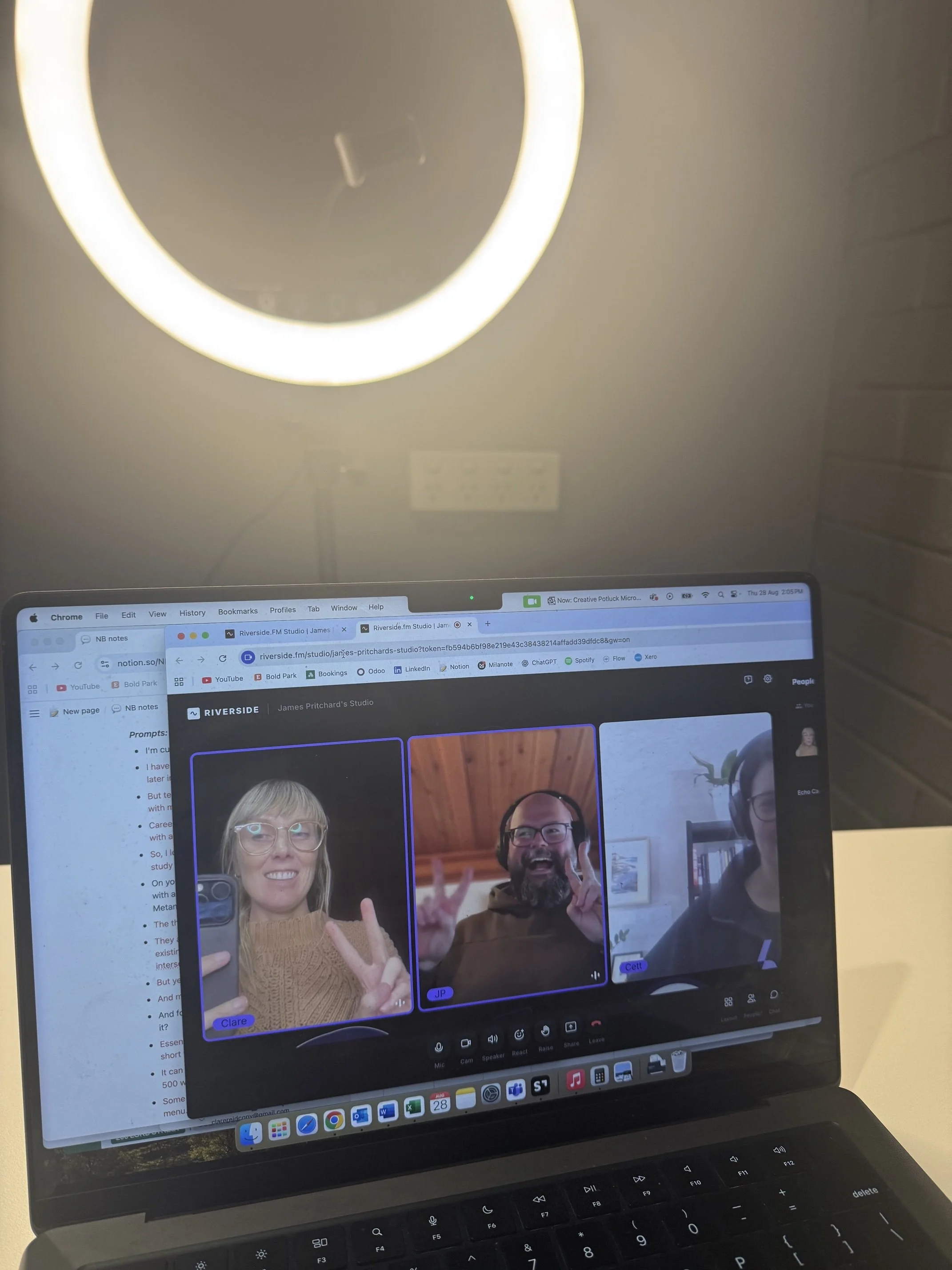
Clare Reid, James Prichard, and Cett Raccuia during recording
0:35
Cett Raccuia
We're beginning to want more time with fewer things.
YouTube videos are stretching past the 20 minute mark.
Podcasts over an hour.
Not this one though, just some.
Oh, who knows, maybe this could be the first.
0:51
And Substack just passed 2 million paid subscribers.
And what about books?
Do we remember those apparently non fiction books set to grow up to 25% in this next year?
So we're told the world has no attention span.
1:07
And yet here we are, staying with stories, spending time reading newsletters and reading whole chapters.
And that's what we're exploring today, the quiet comeback of long form content.
The exciting thing for this episode is we have a guest, Claire Reid, who leads the team at Lush, the content Agency, is the editor of Literature and Creative Industries for the Metamorphosis Journal and lead copywriting copywriting representative for PADC, as well as a published short story author and regular contributor to Arts Hub Magazine.
Unpacking Long-form: Its Definition and Short-form's Toll
9:59
Clare Reid
Yeah, I guess the way that I would think about ‘what is long-form content?’ is essentially the opposite of that scroll hungry demons you become when you consume short-form.
We all know it, everyone listening knows it.
10:15
It's like that version of yourself that you would not want to see that reflected back to you on like a big screen.
12:51
James Pritchard
I think that's an interesting point you make about the exercise of practicing long-form writing or storytelling.
What types of things do you do for yourself to exercise that more regularly?
I imagine in day-to-day copywriting content creation world, it isn't something that perhaps you have to engage on the daily.
13:14
Clare Reid
Well, for our agency it is.
It's really focused on long-form rather than the kind of bite sized pieces of content.
We absolutely write headlines and subheads and you know, the shorter form copy that leads to the longer form piece.
But we're very much in the world of long-form articles, article series, white papers, gated content that is more long-form.
15:03
Clare Reid
I mean, the research is really coming out.
There are ones that are kind of more sensationalised and we're hearing the words brain rot a lot and we're hearing, you know, all these data and stats being thrown at us.
15:18
And I think we're all starting to absorb it in this intersection between like the research and what we're seeing coming out, the laws that are changing around like youth consumption, etcetera.
But we're inspecting that with our own experiences and our own feelings and that you almost feel hungover if you do it for too long or you you prioritise that over sleep or something like that.
15:41
And it's not even a conscious prioritisation.
It's you are as susceptible to those dopamine hits and to that constant engagement because these things are built to engage you in that way.
Brain rot is actually the definition is the deterioration of a person's mental or intellectual state.
16:03
And I think sometimes we have this hyperbole around phrases and words and then they become a little bit easy to ignore because we've heard them so much and you know, they can even become memes and, and all of that.
But when you actually feel it yourself or see it in your kids or things like that, it starts to become far more real.
18:34
Navigating Algorithms: Substack's Rise & Client Needs
20:29
Clare Reid
So if you're scrolling through Instagram and you're scrolling before the picture loads, what are you actually taking from that aside from the emotional hit?
You're not actually learning anything.
You're not absorbing anything and also the challenge I gave myself and I'd give you can listeners as well.
It's like when you a little scroll and you finish, try and remember every piece that you saw.
It's vitally impossible, but it's a really cool way to start having a bit of awareness around your usage.
21:03
Because if you finish scrolling, you know, you saw about 100 clips, 50 clips, 20 clips, depending how long.
And if you try to remember them all, it's so hard.
It's like trying to you remember like two or three.
And even then you don't really know.
21:18
You're not remembering detail, you're not remembering like what they were wearing or anything like this.
Whereas if you ask someone about a novel they really love, they will, they will give you the deets, you know.
So it's a really fun exercise to just see what your brain is actually like you said, Chet, like what it, what are we actually learning or absorbing or even comprehending from this kind of content consumption and.